
Guide: managing buyer customisations

Buyer customisations are an important part of the customer experience. Managed well, they generate margin; managed poorly, they consume time and cause confusion. The difference lies in how selections are organised before the first buyer signs in. This guide explains how a builder should structure buyer customisation management: finish collections, included and extra-cost selections, different project types, a change-work library, pricing, schedules and selection deadlines.
A good buyer customisation process has three objectives that go hand in hand:
- Customers find a solution that suits them without being overwhelmed by the number of options.
- The builder stays with familiar, controlled solutions that the site team can deliver and procurement can order.
- Every change is priced profitably and consistently from one project to the next.
1. Finish collections are the foundation
A finish collection is a coordinated style: a considered combination of flooring, tiles, cabinetry, appliances and fittings that work together. A collection does not restrict choices. It organises them so that the right customer can easily find the right combination.
A collection matches a customer profile. Each collection is designed for a particular type of customer. For example:
- Scandinavian and light – young first-time buyers and families with children
- Dark and stylish – city residents looking for something distinctive
- Classic and timeless – older buyers and people moving home who value longevity
When collections reflect real customer groups, sales staff can guide buyers towards the right combination from the very first conversation.
A collection includes options for different projects. The same style can be achieved at different price and specification levels. For example, a collection may include tiles in the same colour palette: a more affordable option for right-of-occupancy or ARA-funded housing, a standard option for typical owner-occupied developments and a premium option for a development in a high-value area. The style remains consistent, while the project's location, budget and target customers determine which options are offered.
Maintain collections centrally. When collections are shared across projects, product changes only need to be made once:
- Assign someone to own the collections, such as an interior designer or procurement specialist.
- Review collections regularly, for example twice a year: discontinued products, price changes and new trends.
- Update products and prices in a single product register that supplies new projects.
- Track what customers actually select: rarely chosen products are candidates for removal.
2. Included and extra-cost selections
In each project, the buyer's options fall into two groups:
- Included selections are part of the apartment purchase price or contract. The buyer chooses without incurring an additional cost.
- Extra-cost selections are better or more specialised alternatives within the same range, for which the buyer pays the difference.
Included selections must be genuinely good. If the standard option feels like a forced compromise, the customer experience suffers and additional sales do not follow naturally. Each style may have only one included option, but most builders allow buyers to mix across collections: buyers can select any standard or extra-cost option offered in the project, regardless of style.
Keep the number of extra-cost selections manageable. A few extra-cost options per style are usually enough, as buyers can see all of them when mixing across collections. Arrange options in clear tiers so buyers understand what the additional price buys them.
Credits belong in the same system. When a buyer gives up an included product, the credit can be defined, for example, as:
- the full price of the default product
- a proportion of the default product's price, typically 70–80%
- a fixed amount
When the credit policy is agreed in advance, buyers receive consistent answers and each case does not need to be negotiated separately.
3. Different project types
The same collections serve different projects, but each project uses the part of the range that suits it.
New development. There are many buyers, and they usually have months to make their selections. The range can be broader, and extra-cost selections are an important part of the customer experience and margin. A project typically offers two or three collections according to its target customers.
Pipe renovation. Shareholders already live in the building, many have strong views about their own homes and the schedule is tight. Keep the range narrower and clearer. Change and extra work play a greater role because shareholders often want to renew other things at the same time.
Location and price level. Location affects buyer customisations more than many realise. Materials in a suburban development differ from those in a city-centre project, and this is also reflected in the volume of change work. Right-of-occupancy and ARA-funded housing usually stays at the collection's basic level. In high-value areas, spending on extra-cost selections and buyer customisations often exceeds 10% of the apartment price. Premium options and an efficient change-work process are therefore a significant part of the project's margin.
Investor-owned apartments. Investors want buyer customisations to be as efficient as possible. They often aim for the same style in all apartments and may ask the customisation coordinator to make selections for every apartment on their behalf. Prepare a ready-made style combination whose selections are easy to repeat from one apartment to another.
Practical tip: when setting up a new project, start from a previous project of the same type. Copy its range as a starting point and change only what is different in this project.
4. A change-work library: efficient customisation
There will always be a buyer who wants something outside the range: an extra socket, a relocated dishwasher or their own tile choice. A change-work library is the builder's own collection of these recurring requests, with solutions that are already priced and ready to deliver.
Two different things, one library:
- Change work means replacing a product in a category with an established selection range with a product from outside that range, such as tiles suggested by the buyer.
- Extra work means work outside the selection process altogether, such as an additional socket, sanding parquet flooring or recessed ceiling lights.
Change work can arise in two ways. The builder responds to a buyer's quotation request either with its own change product from the library or with a fully bespoke solution. For a bespoke solution, the builder identifies a suitable product or determines whether it can take responsibility for the buyer's proposed product, along with the change's effects on other products and plans. The library makes the first approach more efficient and reduces the need for the second.
Why a library is worthwhile:
- Buyers get customisation, but only solutions the site team knows and can deliver.
- Quotations start from a ready-made template rather than from scratch every time.
- Pricing is consistent across projects and buyers.
The library is the customisation coordinator's tool, not the buyer's selection range. Buyers do not see the change-work library. They submit a quotation request, and the coordinator responds quickly using the library. This keeps the buyer's range clear: displaying every possible change would overwhelm buyers, slow decisions and increase site risks.
Growing the library: whenever the same change request comes up a second time, save it as a template. With a systematic approach, a builder can eventually cover around 70% of quotation requests from the library, sometimes by adjusting a few quotation lines.
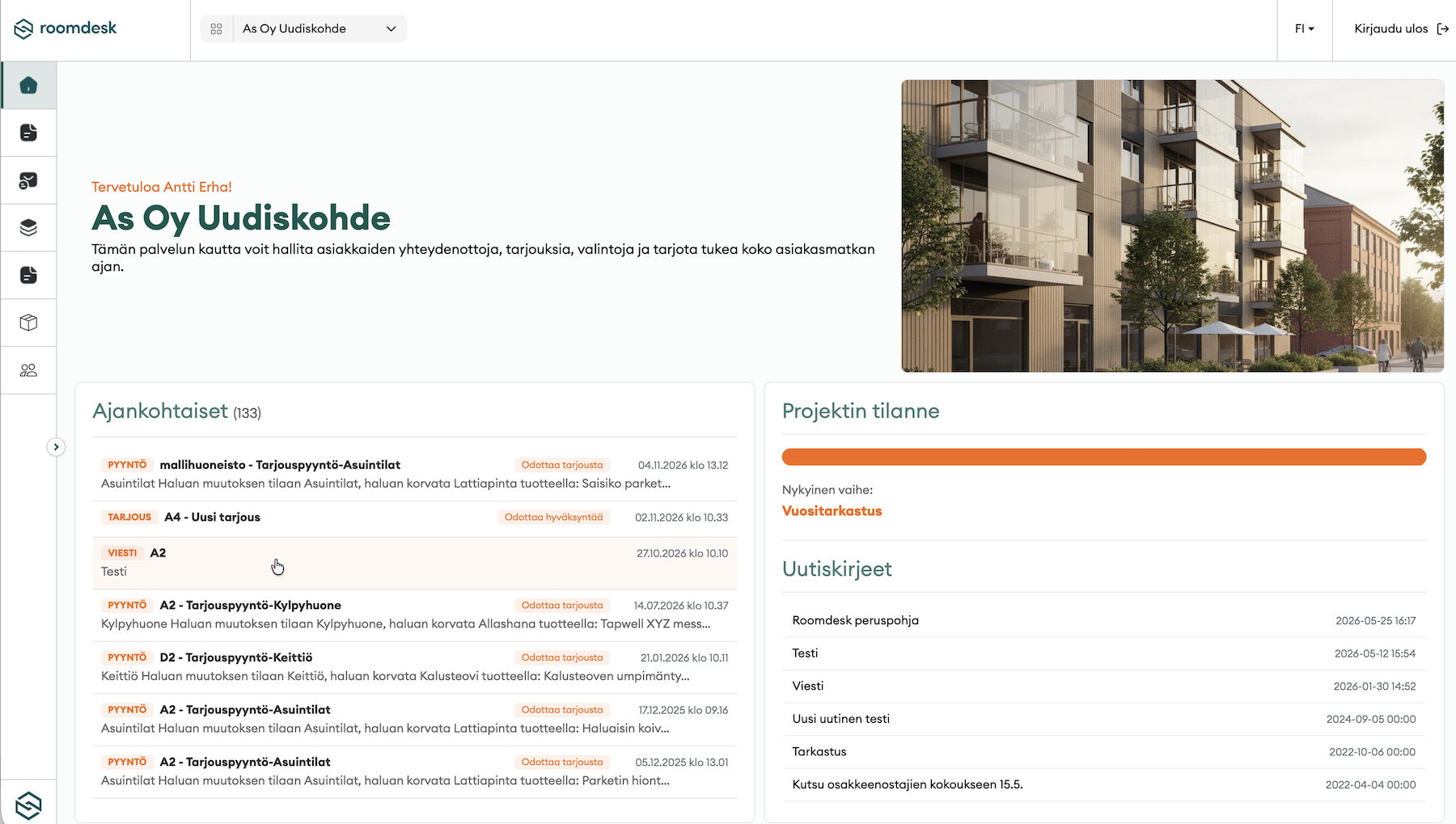
In Roomdesk's administrator view, the customisation coordinator can see the project's current quotation requests, quotations and messages, along with the project stage, at a glance.
5. Pricing change and extra work
Change-work pricing is where margin is either created or lost. Four principles help keep it under control.
Price from resources. Calculate each quotation from its actual inputs: materials, labour, design and administration. An estimated lump sum may feel quick, but over time it either drives customers away or eats into margin.
Use a default margin, but allow exceptions. Agree on a default margin for all quotations. Adjust the margin for individual lines when a product or task requires it. This keeps pricing consistent regardless of who prepares the quotation.
Account for hidden costs. Even a small change creates administrative work: preparing a quotation, ordering, briefing the site team and documenting the change. Set a minimum charge or handling fee for small changes so that adding a single socket is not loss-making.
Make pricing transparent to the buyer. A clear quotation showing what the price includes reduces questions and speeds up approval. When the approved quotation transfers directly to the order confirmation, the buyer has a clear payment obligation and the builder has a documented agreement.
6. Schedules and selection deadlines
Selections need a deadline based on site and procurement requirements, not on the buyer's decision-making process.
- Stagger selection deadlines. Not every selection needs to lock at the same time. For example, building-services provisions and bathroom tiles lock earlier than paint colours or appliances.
- Communicate the schedule from the start. When buyers know the deadlines from day one, decisions do not pile up at the last moment.
- Send automatic reminders. Reminders before a deadline significantly reduce manual follow-up calls.
- Use a default if the buyer does not select. When the deadline passes, the included default option remains in effect. Explain this clearly to the buyer in advance.
- Handle late changes separately. Changes requested after a deadline are considered only if the site can still accommodate them, and a higher handling fee may apply.
7. Checklist for builders
- ☐ Collections are defined around customer profiles, and each collection has an owner.
- ☐ Each collection includes options for projects at different price levels.
- ☐ Products and prices are in one product register that supplies projects.
- ☐ Every selection category includes good standard options and a few clearly tiered extra-cost options.
- ☐ The credit policy is agreed in advance.
- ☐ New projects are set up using a previous similar project as a starting point.
- ☐ Recurring change and extra work is saved as templates in the change-work library.
- ☐ The change-work library is an internal tool for the customisation coordinator, not the buyer's selection range.
- ☐ Change-work prices are calculated from resources, with a shared default margin.
- ☐ Small changes have a minimum charge or handling fee.
- ☐ Selection deadlines are staggered and communicated to buyers from the start.
Roomdesk is built for exactly this: collections, a product register, a change-work library, quotations supporting resource-based costing and selection deadlines in one system. Book a demo, and we will look together at what buyer customisation management would look like in your projects.